bioRxiv (2026)
Lab-on-a-3D-Printer for Democratized Reconfigurable Digital Microfluidics
Ye S, Schremmer BR, Guan Z, Goncharov A, Han GR, Rajasenan V, Falcone N, Li X, McDonough CR, Ozcan A, Di Carlo D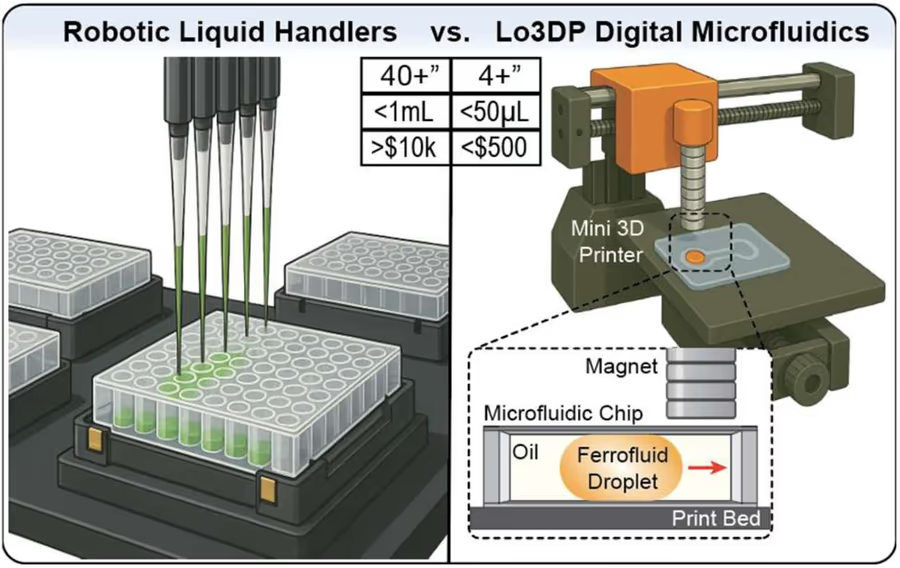



Low-cost, programmable systems for scalable and reproducible biological experimentation.
Modern biology increasingly depends on experiments that are too complex, too multidimensional, or too time-sensitive to perform manually. Yet conventional laboratory automation often requires expensive robotic infrastructure that is inaccessible to many laboratories, educational settings, and distributed diagnostic environments.
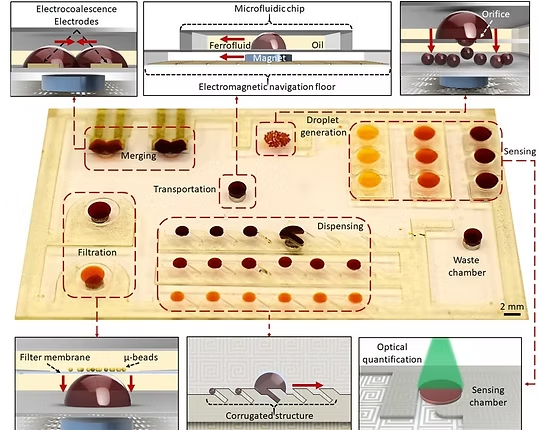
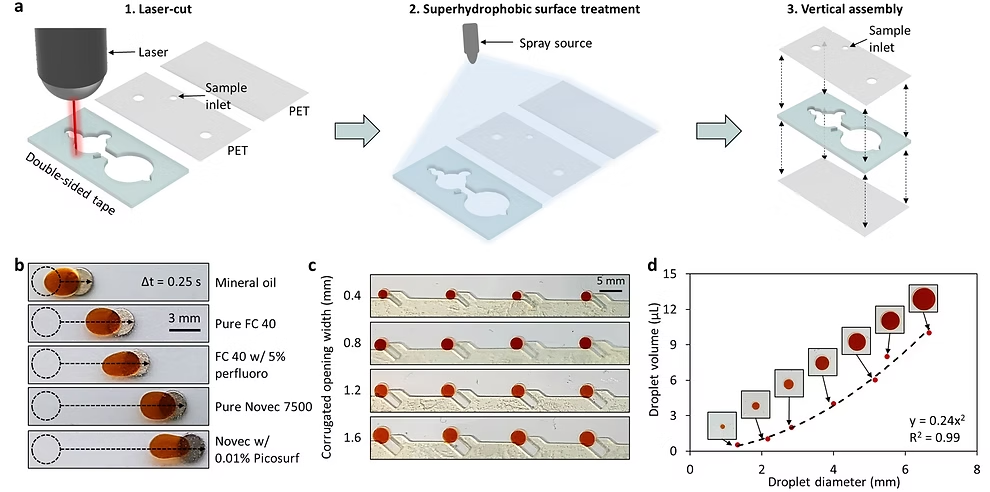
The Di Carlo Lab develops new automation strategies that use microfluidics, magnetic fields, droplets, and repurposed hardware to make experimentation programmable and scalable. Our ferrobotics platform uses magnetic fields to manipulate ferrofluid droplets for adaptable liquid handling. Building on this concept, we are developing lab-on-a-3D-printer systems that transform consumer-grade 3D printers into low-cost laboratory robots. When infused with cutting-edge AI multimodal foundation models these platforms aim to reduce the cost and complexity of laboratory automation.
These platforms are designed to automate assays, nucleic acid testing, diagnostic workflows, and experimental optimization. More broadly, they support a future in which biological discovery is more reproducible, distributed, and accelerated by closed-loop experimentation and AI-guided design.
bioRxiv (2026)
Nature (2022)





Science Robotics (2020)